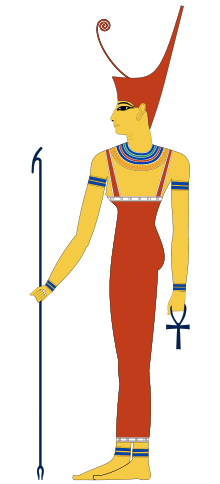
TYPE: Fertility Goddess
ORIGIN: Egyptian (upper)
INFORMATION: Amaunet seems to have a taken role as an early consort of Amun, one of the eight deities of the Ogdoad and representing hidden power. In that context she is depicted anthropomorphically but with the head of a snake. She is shown in reliefs and as the subject of a notable statue from the Record Hall of Tuthmosis III at the Karnak complex of Thebes, where she was recognized as a benign protective deity especially called on at times of royal accession. As a fertility goddess she was largely eclipsed by the goddess Mut. She is sometimes equated with Neith, the creator goddess of Sais, and her attributes may include the red crown of the Delta.
Amunet or Imnt (The Hidden One in hieroglyphics); also spelled Amonet or Amaunet; is a primordial goddess in ancient Egyptian religion. Thebes was the center of her worship through the last dynasty, the Ptolemaic Kingdom, in 30 BC. She is attested in the earliest known of Egyptian religious texts and, as was the custom, was paired with a counterpart who is entitled with the same name, but in the masculine, Amun. They were thought to have existed prior to the beginning of creation along with three other couples representing primeval concepts.
DESCRIPTION AND HISTORY:
Primeval Counterparts:
Her name, jmnt, is a feminine noun that means "The Hidden One". She is a member of the Ogdoad of Hermopolis, who represented aspects of the primeval existence before the creation: Amunet was paired with Amun—whose name also means "The Hidden One", with a masculine ending (jmn)—within this divine group, from the earliest known documentation. Such pairing of deities is characteristic of the religious concepts of the ancient Egyptians. In early concepts known as the Ogdoad, the primeval deity group to which they belonged as "Night" (or as the determinative D41 meaning "to halt, stop, deny", suggesting the principle of inactivity or repose), was composed of four balanced couples of deities or deified primeval concepts.
Speculation exists that Amunet may have been conceived by later theologians as a complement to Amun, rather than being an independent deity originally, however, the Pyramid Texts, the earliest known religious texts of Ancient Egypt, mention "the beneficent shadow of Amun and Amunet":